TRACKER-1ALPHA
48.8566°N / 2.3522°E

Observing / Sun

Space weather

Solar activity, flares, auroras and real-time images of our star.

Live space weather

Kp index
Data unavailable
Solar wind
Data unavailable
Plasma density
protons / cm³
Bz field
undefined nT
Data unavailable
Total B field
undefined nT
Magnetic intensity

The Sun in images

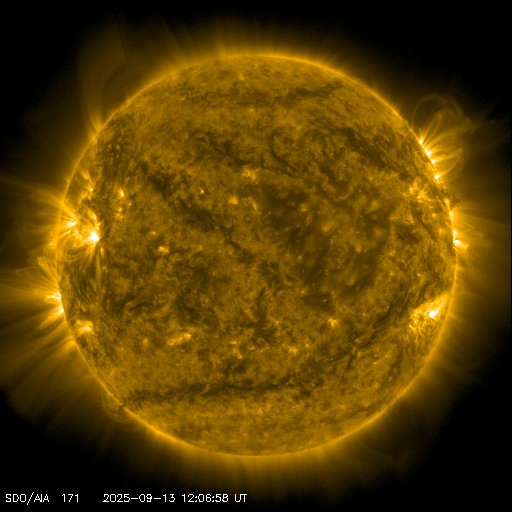
Quiet atmosphere (171 Å)

Shows the quiet solar corona at ~1 million °C.

Source: NASA / SDO

Auroras

Real-time map

Green areas show currently observable aurora probabilities. Source: NOAA OVATION Prime.

Aurora activity
LOADING...
Fetching data...
Aurora colors
Green — oxygen at ~100-250 km (most common)
Red — oxygen at >250 km (rare)
Blue/purple — nitrogen at <100 km
Pink — nitrogen + oxygen (active auroras)
See detailed forecasts on NOAA SWPC →

How do auroras form?

The northern (aurora borealis) and southern (aurora australis) lights are born when the solar wind interacts with Earth's magnetic field.

Step by step

  • The solar wind (charged particles) reaches Earth.
  • Earth's magnetic field deflects most of the particles.
  • Some are channeled toward the magnetic poles.
  • They collide with atoms in the upper atmosphere (100–400 km).
  • Excited atoms emit light as they "de-excite": this is the aurora.

When to see them? Ideally at the equinoxes (March, September), under a clear sky far from cities, with a Kp index ≥ 5.

Photo gallery

Loading aurora photos…

Understanding the Sun

The Sun is a star — a huge ball of hot gas, mostly hydrogen and helium.

It is made up of several layers:

  • The core: at the center, the temperature reaches 15 million °C. This is where nuclear fusion takes place, converting hydrogen into helium and releasing the Sun's energy.
  • The radiative zone: energy produced in the core passes through this very dense region. A photon can take more than 100,000 years to cross it!
  • The convective zone: bubbles of hot gas rise and fall, like in a pot of boiling water.
  • The photosphere: the visible "surface" of the Sun, at ~5,500 °C. This is where sunspots appear.
  • The chromosphere: a thin pink-red layer visible during eclipses.
  • The corona: the outer atmosphere, strangely hotter than the surface (over 1 million °C).

"Space weather" describes the phenomena occurring at the Sun's surface and in its atmosphere that can affect Earth.

Main phenomena:

  • Sunspots: darker, cooler regions of the photosphere, caused by intense magnetic activity. They appear and disappear in ~11-year cycles.
  • Solar flares: sudden explosions releasing huge amounts of energy and radiation. They are classified from A (weak) to X (extreme).
  • Coronal mass ejections (CMEs): huge clouds of magnetic plasma ejected into space. When aimed at Earth, they can trigger geomagnetic storms.
  • Solar wind: a continuous stream of charged particles escaping the Sun at speeds of 300 to 800 km/s.

The Sun's activity follows an approximately 11-year cycle, called the Schwabe cycle.

  • Solar minimum: few sunspots, few flares. The Sun appears calm.
  • Solar maximum: many sunspots, frequent flares, numerous CMEs. The Sun is highly active.

We are currently in solar cycle 25, which began in December 2019. The maximum is expected in 2024-2025, which explains the intense solar activity we are observing now.

During solar maxima, auroras are more frequent and can be seen at lower latitudes than usual.

Impacts on Earth

📡

Communications

Solar storms can disrupt radio communications, particularly the HF frequencies used by aviation and emergency services. GPS signals can also be degraded, affecting navigation.

NOAA SWPC – Impacts of Space Weather

Power grids

Geomagnetically induced currents (GICs) can overload electrical transformers and cause large-scale power outages. In 1989, a solar storm plunged Quebec into darkness for 9 hours.

NASA – Geomagnetic Storms and Power Grids
🛰️

Satellites

Energetic particles can damage satellite electronics, corrupt data and alter their orbit through atmospheric drag. In 2022, SpaceX lost 40 Starlink satellites during a geomagnetic storm.

ESA – Space Weather Effects on Satellites
✈️

Aviation and polar flights

Flights crossing polar regions are exposed to increased radiation during solar storms. Airlines may reroute flights to avoid the most affected areas.

NOAA SWPC – Aviation Impacts
🧑‍🚀

Astronauts

Astronauts on space missions, especially those on the ISS, are particularly vulnerable to solar radiation. During flares, they must take shelter in the most shielded areas of the station.

NASA – Space Radiation and Astronauts
🌌

Celestial beauty

Despite these risks, solar activity also gives us one of nature's most beautiful spectacles: the northern and southern lights. These dances of colored light attract thousands of travelers to polar regions every year.

NOAA – Aurora

Data provided by NOAA Space Weather Prediction Center, NASA Solar Dynamics Observatory and Flickr. This information is adapted for the general public.